How to Paint Board and Batten Siding (Without Cracks or Trapped Moisture)
Board and batten siding moves, breathes, and traps moisture differently than flat walls. Learn how to paint it properly — and why breathable paint performs better.
TECHNICAL
Dalsberg
1/23/20263 min temps de lecture
Board and batten siding is bold, architectural, and deeply rooted in North American building traditions, and imported by northern european settlers.
But painting board and batten siding comes with specific challenges that many exterior paints are not designed to handle.
This guide explains:
how board and batten siding moves and behaves outdoors
why some paints crack or fail at the battens
and what type of exterior paint actually lasts on this structure
Why board and batten siding behaves differently
Board and batten siding is not a flat surface.
It is often made with raw wood by people who would like to see the wood grain, but who are forced to cover it with synthetic paints.
It combines:
wide vertical boards
narrow battens covering the joints
multiple thicknesses of wood
overlapping edges
This design creates movement in different directions:
boards expand and contract across their width
battens move independently
joints concentrate stress and moisture
That’s why paint failures usually start:
along the battens
at board edges
where wood thickness changes.
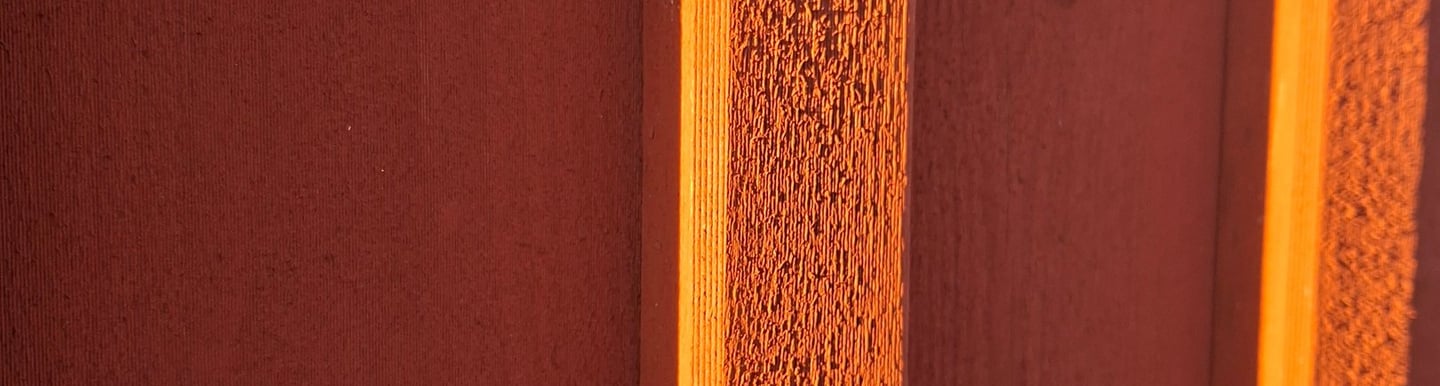
However, Dalsberg paint saturates the outer layers. By soaking into the wood a little, it will pass under the overlapping boards, which will prevent the appearance of gaps where the boards meet, as they will naturally expand by a few millimeters.
Unlike board and batten siding, Dutch lap siding relies on overlapping horizontal profiles that require consistent vapor release behind the paint layer.
Can you paint board and batten siding?
Yes — board and batten siding can absolutely be painted.
But the paint must tolerate:
vertical movement
joint compression
moisture accumulation behind battens
Paints that rely on a rigid or semi-rigid film struggle here.
Why many exterior paints fail on board and batten
Most modern exterior paints are film-forming.
They create a continuous synthetic layer that looks clean and uniform.
As long as the film remains elastic, it can:
stretch with temperature changes
resist UV exposure
look flawless for years
The problem
Board and batten siding traps moisture at the joints.
When moisture enters the wood but cannot escape:
pressure builds behind the paint
stress concentrates at the battens
cracks, splits, or peeling appear
Sometimes the paint fails visibly.
Other times it stays intact while moisture damages the wood underneath.
👉 Background logic: Why Old Barn Paint Didn’t Peel
Best paint behavior for board and batten siding
The best paint for board and batten siding is not the hardest or thickest coating.
It’s a paint that allows the structure to behave naturally.
Look for paint that is:
✔ Breathable by design
✔ Non-film-forming
✔ Matte or mineral-based
✔ Compatible with wood movement
This allows moisture to escape — especially at battens and joints.
Film-forming vs breathable paint on board and batten siding
Film-forming paints (acrylic, latex)
Create a sealed surface
Concentrate stress at battens
Crack along joints
Require heavy scraping later
Breathable paints (heritage / mineral-based)
Penetrate surface fibers
Let moisture move outward
Age gradually instead of failing suddenly
Refresh easily without stripping
👉 Related: Best Exterior Wood Paint — Breathable vs Film-Forming
Application tips specific to board and batten siding
Good news: application is simple.
Best practices:
Light brushing to remove dust
Wood must be dry
Use a wide brush (better control at joints)
Work into the grain
One generous coat is usually enough
Avoid flooding the battens — paint should soak in, not build thickness.
👉 See: Applying Barn Paint — Simple Techniques
Climate plays a major role
Board and batten siding is especially sensitive in:
humid climates
shaded facades
cold regions with freeze–thaw cycles
Breathable paint performs better because it never traps moisture at the joints, where the first unsightly cracks appear.
This is why similar paint systems were historically used on:
barns
cabins
sheds
agricultural buildings
Across North America.
Best colors for board and batten siding
Board and batten responds especially well to:
deep matte blacks
dark browns
mineral reds
anthracite and charcoal grays
These tones:
visually unify boards and battens
reduce contrast at joints
age more evenly over time
👉 Related inspiration: Black Wood Siding — When It Works (and When It Doesn’t)
So what is the best paint for board and batten siding?
The best paint for board and batten siding is one that:
respects vertical wood movement
allows moisture to escape
fades instead of cracking
simplifies long-term maintenance
That’s why breathable, non-film-forming exterior paints — inspired by traditional barn paint — remain one of the most reliable choices.
They don’t fight the structure.
They work with it.
Professional quotes available for large siding and exterior wood projects.

We usually reply within 24-48 business hours
Free shipping included — typically delivered within 6–9 business days across the United States and Canada using trusted carriers. Import duties are currently covered by Dalsberg Paint.
Secure payments : Credit card, PayPal, Bank transfer
DALSBERG® is a registered trademark of Dalsberg Paint. All rights reserved.
Dalsberg Paint – operated by Jean- François Luya, sole proprietorship registered in Sweden
VAT SE800626823201
D-U-N-S® Number 778594247
Visit Dalsberg peintures for France Belgium and Switzerland